



Owning a vacant plot in India while living abroad feels safe — until one day you receive an unexpected call.
Someone has occupied your land.
A boundary wall has disappeared.
Or worse — legal complications have begun.
The biggest problem is not distance.
The biggest problem is not knowing what’s happening.
For many NRIs, property ownership back home is meant to be an investment, a future plan, or a piece of emotional security. But when a plot remains unattended, it can slowly turn into a source of stress, confusion, and unexpected problems.
Vacant land, by its very nature, invites risk — especially when no one is regularly checking on it.
Let’s talk about the issues that property owners often discover too late.
Why Vacant Plots Are More Vulnerable Than You Think
A vacant plot doesn’t have doors, locks, or daily activity. There’s no natural deterrent. No one notices small changes. No one questions unusual activity.
When you live abroad, months — sometimes years — can pass without physically seeing your land. By the time something feels “off,” the problem may already be complicated.
Most plot-related problems don’t start dramatically.
They start quietly.
11 Problems NRIs Commonly Discover Too Late
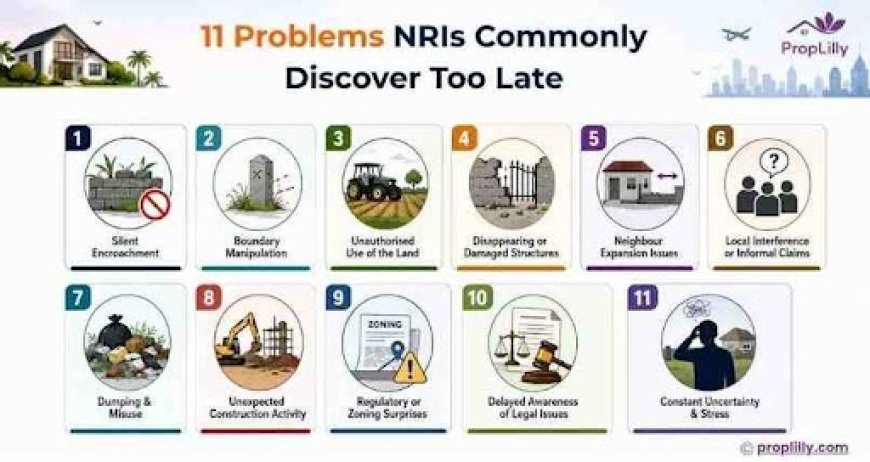
1. Silent Encroachment
This is one of the most common fears among NRI property owners — and for very valid reasons. Contrary to popular belief, encroachment rarely happens overnight. In many cases, it begins subtly: a temporary structure, slight land usage, or small boundary adjustments that don’t immediately raise alarm.
For owners living abroad, these gradual changes are almost impossible to detect without regular physical checks. Months or even years may pass before the issue becomes visible. By the time the owner becomes aware, removal can involve legal hurdles and serious expense.
2. Boundary Manipulation
Boundary stones moved. Fencing adjusted. Walls altered.
These changes may appear minor, but they carry serious long-term consequences. Property boundaries define ownership, yet they can be surprisingly vulnerable to unnoticed alterations. Small physical shifts are extremely difficult to recognise from afar, especially when owners lack recent photographic records.
Without documented visual evidence, proving the original state of the land can become complicated. What could have been a simple clarification may escalate into a stressful disagreement or legal complication. This is why consistent visual verification plays such a critical role in protecting vacant plots.
3. Unauthorised Use of the Land
Vacant plots often attract temporary or informal usage. People may use open land for parking vehicles, storing construction materials, small-scale farming, or other short-term arrangements. At first glance, such activities may seem harmless or reversible.
However, extended usage can gradually create expectations, misunderstandings, or even conflicts. Owners may later find themselves dealing with disputes that could have been prevented through early awareness. The risk lies not only in the activity itself but in the owner remaining unaware while it develops.
4. Disappearing or Damaged Structures
Compound walls, fencing, gates — these protective elements require periodic inspection and maintenance. Over time, they may suffer damage from weather conditions, wear and tear, or human interference. Unfortunately, such changes rarely trigger immediate alerts for absentee owners.
A broken fence or altered wall can significantly increase the vulnerability of the plot, making it more susceptible to misuse or encroachment. When issues are discovered late, restoration becomes reactive rather than preventive, often adding avoidable expense and inconvenience.
5. Neighbour Expansion Issues
In certain situations, neighbouring properties may slowly extend usage into vacant areas, sometimes unintentionally. Without regular visual monitoring, such shifts can remain unnoticed for long periods. Even minor misunderstandings regarding boundaries can evolve into larger disputes.
Resolving these situations later may involve detailed verification, negotiations, or legal clarification. Early visibility helps prevent ambiguity, ensuring that small issues do not escalate into prolonged conflicts.
6. Local Interference or Informal Claims
Absentee-owned land can occasionally attract unwanted attention, curiosity, or informal claims. Local parties may attempt temporary arrangements, misunderstand ownership details, or create pressure that places the owner in an uncomfortable position.
Distance limits the owner’s ability to assess situations confidently or respond quickly. Even when concerns are unfounded, the lack of clarity can create stress and uncertainty. Reliable ground-level updates help owners maintain confidence and control.
7. Dumping & Misuse
Vacant land sometimes becomes a convenient dumping space for debris, waste, or unwanted materials. Such misuse may remain unnoticed until a physical visit occurs, by which point cleanup may require both time and money.
Beyond the immediate inconvenience, dumping can affect property perception, neighbouring relations, and overall land value. Preventing misuse through periodic checks is far easier than resolving accumulated damage later.
8. Unexpected Construction Activity
Excavation, material storage, or temporary structures can be early indicators of unauthorised construction. Without regular site inspections, these warning signs may easily go unseen by absentee owners.
Delayed awareness can introduce complex legal and logistical challenges. Early detection allows owners to verify, question, and address unusual developments before they become serious problems.
9. Regulatory or Zoning Surprises
Local regulations, zoning policies, and development conditions evolve continuously. Owners disconnected from ground realities may remain unaware of changes affecting land usage, access, or valuation potential.
Periodic verification ensures that owners stay informed and prepared. Awareness helps prevent unpleasant surprises during resale, construction planning, or legal review.
10. Delayed Awareness of Legal Issues
Many plot-related complications only come to light during critical moments — such as property transactions, development plans, or third-party disputes. Issues that existed quietly for years suddenly demand urgent attention.
Early visibility and documentation significantly reduce the likelihood of such scenarios. Proactive monitoring helps identify irregularities before they escalate into legal complications.
11. Constant Uncertainty & Stress
Even in the absence of visible problems, many owners experience a persistent question:
“Is everything okay with my plot?”
This uncertainty itself becomes a burden. Lack of reliable updates creates doubt, hesitation, and anxiety. Regular monitoring does not merely protect the asset — it also restores peace of mind.
A Pattern Behind Most Plot Problems
Interestingly, most of these issues share a common root cause.
Not fraud.
Not bad luck.
Not even distance.
But lack of visibility.
Problems grow because no one notices them early.
Why PropLilly Property Monitoring Changes Everything
When a vacant plot is periodically checked, photographed, and documented, risks reduce dramatically.
Regular monitoring helps owners:
-
Stay informed about actual site conditions
-
Detect unusual changes early
-
Maintain visual records
-
Feel more in control of their asset
This is exactly why many overseas property owners now trust professional plot monitoring services built specifically for NRIs.
It’s not about reacting to problems.
It’s about preventing surprises.
A Practical Mindset for Plot Owners
If you own vacant land, a simple question helps:
“When was the last time I had verified visual proof of my plot’s condition?”
If the answer is unclear, a structured approach helps. Things like:
-
Boundary status
-
Physical condition
-
Signs of activity
-
Surrounding developments
A basic plot monitoring checklist can make this process easier.
The Real Risk Most Owners Overlook
Owning a vacant plot is not the problem.
Owning one without visibility and reliable updates is.
Distance is manageable.
Uncertainty is what creates anxiety.
Stay Informed. Stay in Control.
If your plot in India is unattended, periodic monitoring can help you detect issues early, maintain documentation, and gain peace of mind.